
Acadia Parish Arrest Records and Charges
Acadia Parish arrest records begin with the arresting agency. The Acadia Parish Sheriff's Office and other local police agencies may create booking, custody, incident, or arrest paperwork. The court charge record begins later, when the prosecutor files a charge in court. Research for Acadia Parish identifies the 15th Judicial District Attorney as the prosecution office for Acadia, Lafayette, and Vermilion parishes. Donald D. Landry is listed as district attorney, and the Acadia courthouse office is listed on the DA location page.
The Clerk's criminal case file is the place to verify what charges were actually filed after an arrest. The Clerk's records can include charges, bills of information, indictments, arraignment minutes, pleas, motions, orders, sentencing minutes, probation or revocation documents, and dispositions. Current custody or jail-population details belong with inmate records. The full court case file and outcome belong with criminal court records. This arrest-to-charge split is important because an arrest may not lead to every charge first discussed at booking.
Search Acadia Parish Arrest Records
There is no single local source in the research that proves a public mugshot or booking database for all Acadia Parish arrest records. The sheriff publishes a JADES jail population URL, but it was not reachable during research, and the Sheriff's page says the jail population site works best with Internet Explorer. For arrest-to-charge research, start with the court and prosecutor side once charges are filed, then use the sheriff and jail channels for booking or custody confirmation.
- Confirm whether the person is in current custody through the Acadia Parish Sheriff's Office, the JADES jail population URL if it works, or the Criminal Justice Center phone channel.
- Check Clerk Connect if Acadia criminal access is enabled, because filed charges become Clerk court records.
- Use the 15th JDC Court Calendar for hearing context, especially after arraignment or a scheduled court appearance.
- Call the Acadia Parish Clerk of Court at (337) 788-8881 or Copy and Research extension 332 for copies, older files, and certified charge dispositions.
- For warrants, bonds, or traffic fines tied to a charge, call the Sheriff's Traffic and Bonds line at 337-788-8710.
The Clerk fee schedule lists a $20 criminal history search for 30 years. Older criminal records are handled through indexes and public viewing during normal business hours, and older files may require a pre-arranged appointment if they remain of record. A person checking charges after arrest should search by name, case number, ticket number, date range, and issuing court when those details are available.
Charges Filed After Arrest
Formal court charges are filed by the prosecutor, not by the jail clerk. In Louisiana criminal practice, charging documents can include a complaint, bill of information, or indictment. The exact document depends on the charge, court level, and prosecutor action. The filed document is the point where the accusation becomes a court record that can move through arraignment, motions, plea, trial, dismissal, or sentencing.
| Document | Who Files or Issues It | What It Means for Acadia Parish Charges |
|---|---|---|
| Complaint | Officer or prosecutor | May start a lower-level or early criminal matter and set out the alleged offense. |
| Bill of information | District Attorney | A prosecutor-filed charge often used in Louisiana criminal court cases. |
| Indictment | Grand jury | A formal felony charge returned by a grand jury, often for more serious cases. |
The manifest assigns three small succession law images to this charge-record page. The first comes from Louisiana Code of Civil Procedure Article 3421, a probate source rather than a charging-paper source.
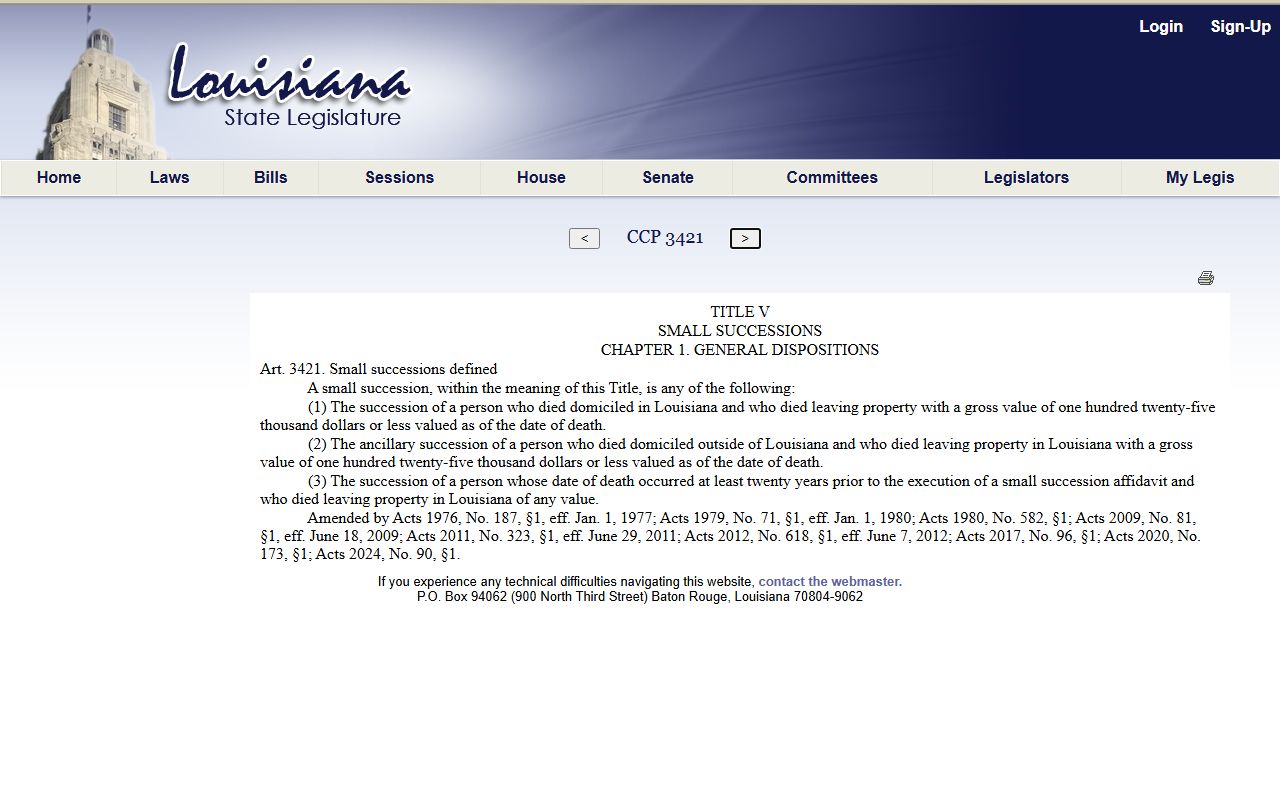
Although that image is not criminal-specific, it still reflects the broader court-record environment where Acadia Parish case files are tied to official Louisiana statutes and Clerk records.
Acadia Parish Charge Status
Charge status can change many times between arrest and final disposition. A charge may be pending at first, then amended, reduced, dismissed, or replaced. Louisiana court records may also use the term nolle prosequi when the prosecutor declines to proceed with a charge. Do not read the first booking accusation as the final court outcome. The most useful record is often the latest certified disposition or sentencing minute from the Clerk.
| Status | Meaning | Where to Verify |
|---|---|---|
| Pending | The charge is filed and no final outcome has been entered. | Clerk docket, court calendar, or court minute entry. |
| Amended | The charge description, count, severity, or statute reference changed. | Amended bill, minute entry, or prosecutor filing. |
| Reduced | A lesser charge replaced or resolved the original accusation. | Plea paperwork, disposition, or sentencing minute. |
| Dismissed | The court ended the charge without conviction on that count. | Disposition entry or signed order. |
| Nolle prosequi | The prosecutor chose not to pursue that charge further. | Prosecutor filing, court minute, or final disposition. |
The second assigned source image comes from Louisiana Code of Civil Procedure Article 3432, another official law source captured for this page_id.
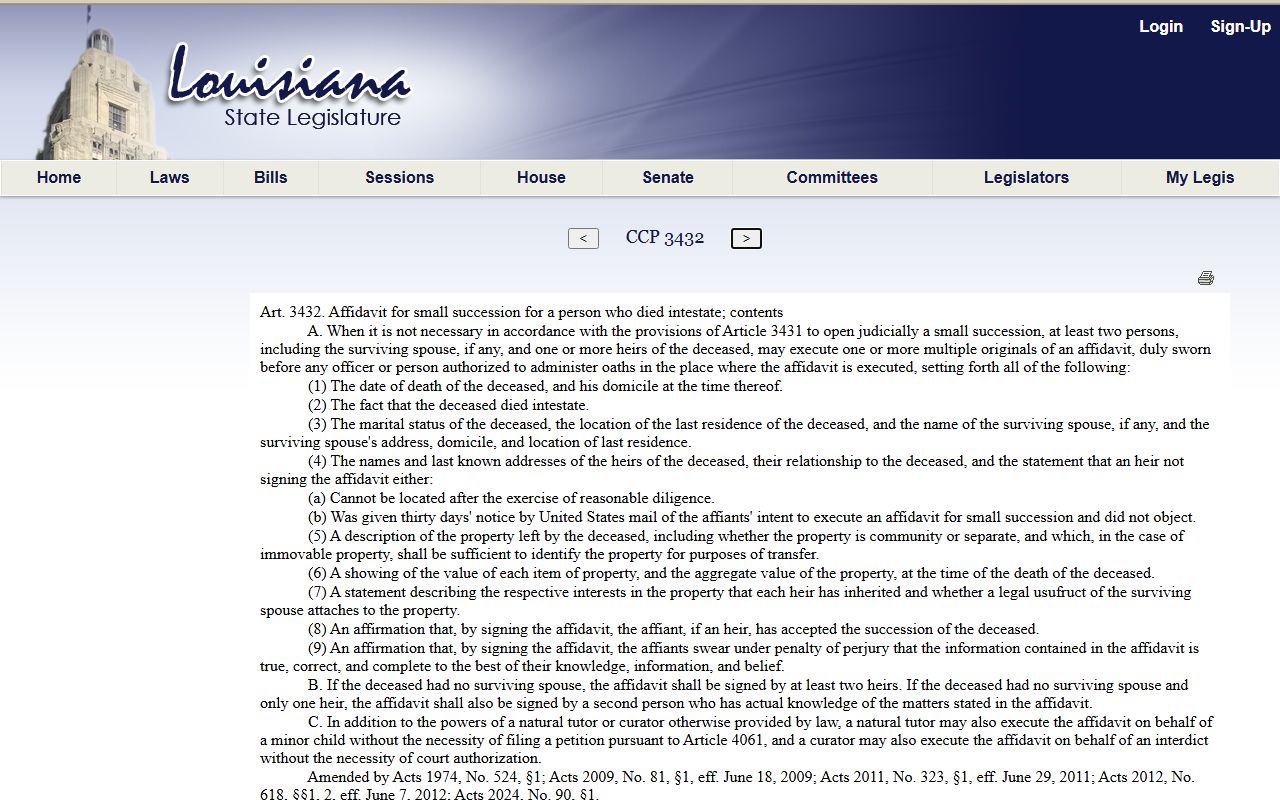
Its main use here is as a source-backed visual, while the charge-status details come from the Acadia court, Clerk, sheriff, and DA research sections.
Charges vs Convictions
A charge is not proof of guilt. It is a formal accusation filed after arrest or investigation. A conviction is a final result after a guilty plea or a finding of guilt. Acadia Parish arrest records may show an arrest reason, while Acadia Parish court charge records show what the prosecutor filed. The criminal case record then shows whether the filed charge ended in conviction, dismissal, acquittal, reduction, or another result.
| Point | Charge | Conviction |
|---|---|---|
| Record stage | After arrest or prosecutor filing. | After guilty plea or guilty verdict. |
| Record source | Booking record, charging document, docket, or amended filing. | Disposition, judgment, plea minute, or sentence. |
| Can it change? | Yes. Charges may be amended, dropped, reduced, or dismissed. | Only through later court action, appeal, post-conviction relief, or expungement limits. |
| Best proof | Filed charging paper and current charge status. | Certified disposition or sentencing minute from the Clerk. |
The Acadia Parish Clerk fee schedule is useful here because the office lists criminal history searches and certified copies. If a charge status will be used for a formal purpose, ask for a certified copy instead of relying on a screen view.
DA and Defense Channels
The District Attorney decides which charges to file and how to proceed with prosecution, plea, diversion, dismissal, or trial activity. The DA's Acadia Parish office is listed at the courthouse, 500 North Parkerson Ave., 3rd Floor, Crowley, LA 70526, phone (337) 788-8831. The DA location page lists district office hours as 8:30am to 4:30pm Monday through Friday. Victim services, prosecution status, and plea negotiation issues are DA matters, but public case copies still route through the Clerk when they are part of the court file.
The Louisiana Office of the State Public Defender lists a District 15 Acadia Parish office at 112 East Hutchison, Crowley, LA 70526, phone (337) 788-3635, with hours Monday through Friday, 8:30am to 4:30pm. The public defender represents eligible indigent accused persons. The defense office is not a public charge lookup desk, but its role helps explain why a case file may show appointment of counsel, motions, plea entries, or hearing continuances.
The fourth assigned image for this page comes from the Louisiana Workforce Commission, which is not a criminal charging source.

Because it was a successful manifest image for this page_id, it is included with its source, while the charge procedure itself relies on the local DA, Clerk, court, and sheriff research.
Sheriff Booking and Bonds
The Acadia Parish Sheriff's Office is the local law enforcement and jail channel listed at 1037 Capitol Avenue, Crowley, LA 70526, with main line 337.788.8700. The Sheriff's Traffic and Bonds division processes warrants, bonds, and traffic fines and gives a deputy traffic contact number of 337-788-8710. That channel is important when the arrest record leads to bond questions, failure-to-appear issues, traffic fines, or warrant processing.
The sheriff app is listed on Google Play and the Apple App Store. The captured app descriptions mention reporting crimes, submitting tips, interactive features, public safety news, and information. They did not verify an app-only arrest record, warrant, or inmate lookup. Do not treat the app as a confirmed arrest records search unless later app inspection proves that function.
Note: The official jail roster URL was not reachable during research, so call the sheriff or jail to confirm current custody.
Sealed and Expunged Charges
Some arrest records and court charges are not available through ordinary public searches. Juvenile records are confidential under Louisiana Children's Code Article 412. Expungement under Louisiana Code of Criminal Procedure Article 971 et seq. can restrict public access to eligible arrest and prosecution records after a court order. Sealed warrants, safety-sensitive records, protected identifiers, victim information, and active investigative material may also be withheld.
| Point | Sealed | Expunged |
|---|---|---|
| Public result | Hidden from routine public inspection. | Restricted from public access after a successful petition. |
| Applies to | Records sealed by rule, law, or court order. | Eligible arrest or prosecution records under Louisiana procedure. |
| Still visible to some? | Authorized courts or agencies may retain limited access. | Some law enforcement or statutory users may still have access. |
| Local action | Ask the issuing court or Clerk what order controls access. | File in the court connected to the Acadia arrest or prosecution. |
The third assigned law image comes from Louisiana Code of Civil Procedure Article 3432.1.
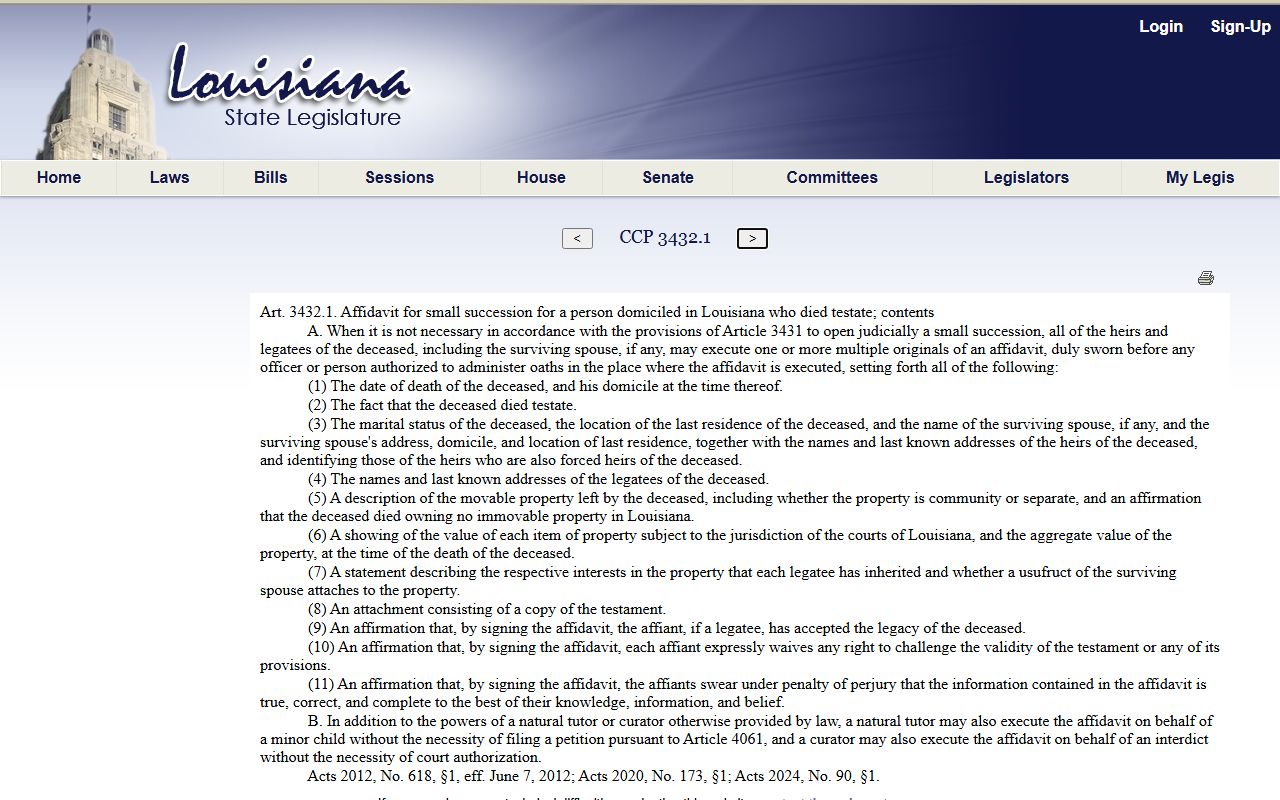
That source is probate-specific, so it is not used to state charge rules; the restriction rules above come from the criminal, juvenile, and public-access research.
Public Access to Charge Records
La. R.S. 44:1 and La. R.S. 44:32 support public-records inspection and copying, subject to state limits. For Acadia Parish arrest records, the custodian may be the Sheriff's Office or arresting police agency. For court charges after arrest, the custodian is usually the Clerk once the prosecutor files the case. For protective orders, traffic tickets, federal cases, or state-prison records, use the agency that controls that record type.
Background checks have a separate legal setting. Public charge records are not consumer reports and should not be used for credit, employment, housing, insurance, or other FCRA-regulated screening. For a formal criminal history, certified disposition, or older search, use the Clerk's copy and history-search process and confirm fees directly with the office.